

LEGO® Serious Play® for Multigenerational Teams: Bridging the Workplace Generation Gap
Most workplaces today hold up to five generations at once. That spans Baby Boomers in senior leadership and Gen Z employees just starting out. Each group brings different communication habits and different assumptions about hierarchy. They also carry different expectations about feedback and flexibility. Traditional meetings often let the loudest or most senior voice dominate the conversation.
LEGO® Serious Play® gives every generation the same tool: bricks, not job titles. Participants build and explain models instead of arguing positions. That removes the usual cues — seniority, tenure, confidence with public speaking — that let generational bias shape a discussion. It gives HR and L&D leaders a structured way to surface and resolve generational friction. That matters before it affects retention or execution.
LEGO® Serious Play® helps multigenerational teams communicate more effectively. It replaces verbal debate, where tenure and confidence often win, with hands-on model building. Every participant explains their thinking in the same format, regardless of age, title, or years of experience.
Why Multigenerational Teams Struggle to Communicate
Generational friction at work rarely shows up as open conflict. Instead, it shows up as quiet disengagement. A newest hire stops speaking up in meetings. A veteran manager feels their experience is being dismissed. Or a project stalls because two age groups assumed different things about how decisions get made.
The Five Generations Now Sharing One Workplace
Many organizations today employ a mix of Traditionalists, Baby Boomers, Generation X, Millennials, and Generation Z. Sometimes all five sit on a single team. Each generation entered the workforce under different economic conditions, technology norms, and management styles. Those early experiences shape how people expect meetings, feedback, and career progression to work.
Where the Real Friction Comes From
The friction usually isn’t about values. Most employees, across every generation, want respect, clear expectations, and meaningful work. It’s about format. Younger employees may hesitate to challenge a senior colleague directly. Senior employees may feel a quick chat message doesn’t carry the weight of a real conversation. Traditional meetings tend to reward whoever speaks first and holds the most seniority in the room. That quietly excludes everyone else.
How LEGO® Serious Play® Levels the Playing Field
LEGO® Serious Play® was designed around a simple idea. If everyone builds a model and explains it, everyone contributes in the same format. They do it at the same time, using the same materials. That structure does a lot of the work that generational sensitivity training alone struggles to achieve.
A Shared Language That Skips Job Titles and Jargon
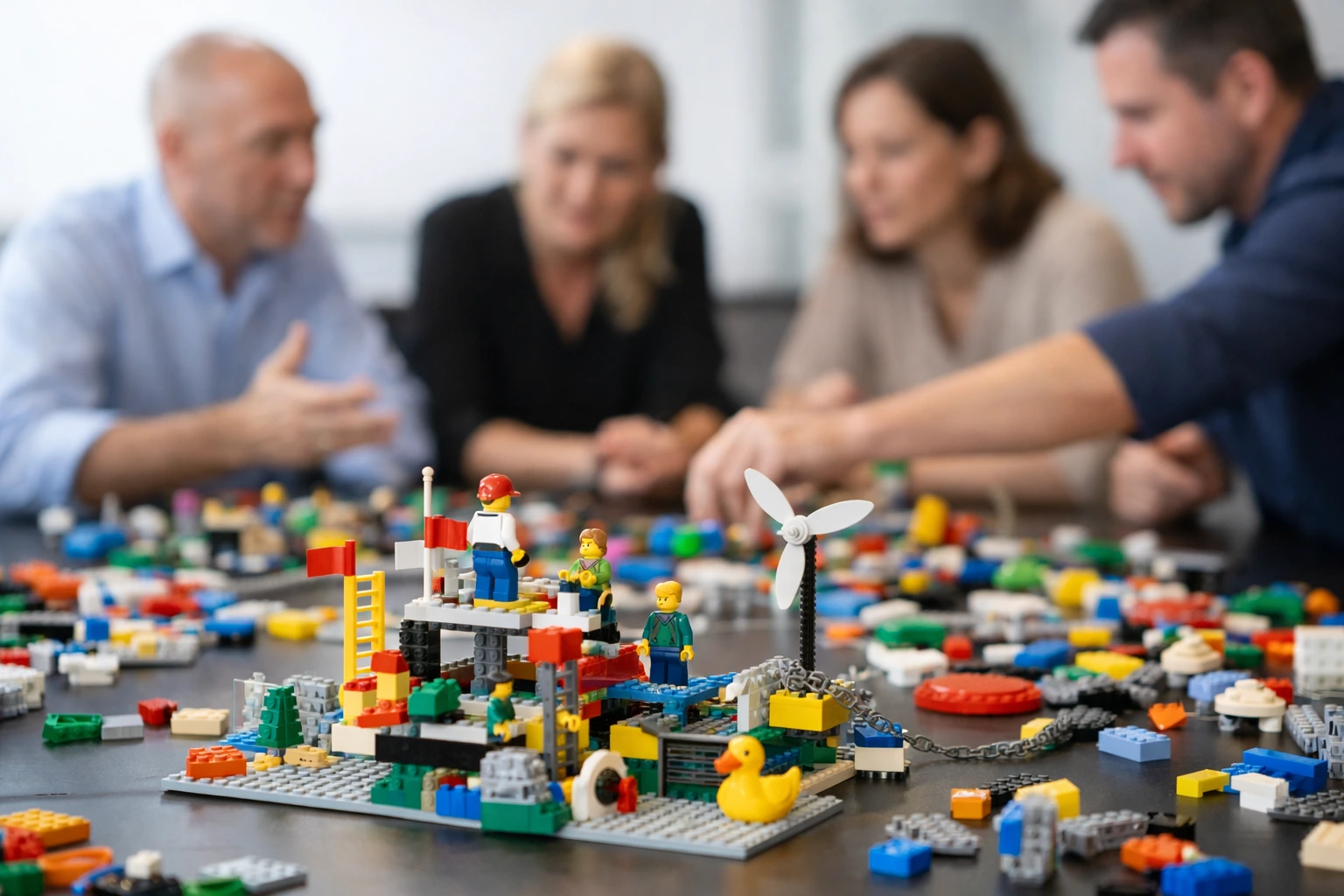
Instead of asking a mixed-generation team to debate a topic verbally, a facilitator gives everyone the same building prompt. For example: “build a model of what good collaboration looks like on this team.” A 22-year-old associate and a 58-year-old director build side by side, using the same bricks. Each person explains their own model in their own words. Job title stops being the thing that determines whose idea gets heard first.
Why Physical Building Beats Verbal Debate Across Age Groups
Building a model takes time and focus. That naturally slows the group down before anyone starts arguing a position. Participants think through their idea with their hands before they defend it out loud. The conversation that follows tends to be more considered and less defensive. This works equally well for a generation that grew up debating in open-plan offices. It also works for a generation that grew up messaging asynchronously. Neither format is favored over the other.
When everyone builds and explains a model the same way, seniority stops working as a shortcut. It no longer decides whose opinion carries more weight in the room.
Common Use Cases for Multigenerational Workshops
HR and L&D teams tend to bring in LEGO® Serious Play® for generational alignment at a few specific moments. These are the moments when the cost of a communication gap is highest.
- Onboarding Gen Z into established teams: new hires build a model of what they need to feel confident contributing. Existing team members build what they wish they’d known in their first 90 days.
- Succession planning and institutional knowledge transfer: departing senior employees and their successors build models together. These models capture the unwritten rules and relationships that don’t show up in a handover document.
- Redesigning hybrid work norms across generations: teams build a shared model of what “responsive” and “available” actually mean. Those words carry very different assumptions, depending on when someone started their career.
- Cross-generational mentoring launches: pairs build models of what they each hope to give and get from the relationship. This reduces the awkwardness of a first mentoring conversation.
Generational friction does the most damage during onboarding, succession, and hybrid work redesign. Those are also the moments where a structured, hands-on conversation pays off the most.
How to Choose the Right Format for Your Team
Not every generational tension needs a full-day workshop. The right format depends on team size and how much time you have. It also depends on whether the team is co-located, hybrid, or fully remote.
Team Size and Session Length
Smaller teams of 6 to 12 people can usually work through a generational alignment topic in a single session. That session typically runs 2 to 3 hours. Larger departments, or sessions that combine onboarding with generational alignment, tend to need a half-day format. That gives enough time for both individual builds and shared reflection.
In-Person vs. Virtual Considerations
In-person sessions make the physical, side-by-side building especially effective for breaking down hierarchy. Everyone is literally at the same table. Virtual sessions work well too, using mailed kits or digital collaboration tools. They can be a practical choice for distributed teams that span multiple offices or time zones. That’s increasingly common across generational lines, as more senior employees split time between office and home.
Running a Multigenerational Workshop: A Step-by-Step Guide
A certified facilitator typically structures a generational alignment session in three stages. Those stages are individual building, shared storytelling, and a commitment to specific next steps.
Click the ‘+’ button below to explore the detailed workshop stages.
Stage 1–2: Warm-Up and Individual Builds
1. Warm-Up & 2. Individual Builds
1. Warm-up (10–15 minutes): Participants build a quick, low-stakes model, often something like “build a tower.” This gets everyone comfortable with the bricks before real content begins. The step matters more for a multigenerational group than it might seem. It gives less confident builders, of any age, a chance to practice without pressure.
2. Individual builds (20–30 minutes): Each participant builds a model in response to a targeted prompt about the actual topic. For example: “what does feeling respected on this team look like to you?” Everyone builds independently, so no one’s model is influenced by watching a colleague’s first.
Stage 3–4: Shared Storytelling and Pattern Building
3. Shared Storytelling & 4. Pattern Building
3. Shared storytelling (30–45 minutes): Each person explains their model to the group, uninterrupted. The facilitator’s main job here is to protect that airtime. This is the step where generational habits tend to resurface if not actively managed. Younger employees may defer. Senior employees may talk longer.
4. Pattern building (20–30 minutes): The group looks across all the individual models for shared themes. Together, they build a combined model that represents where the team actually agrees. That overlap is often bigger than earlier verbal conversations suggested.
Stage 5: Commitments and Action Plan
5. Commitments and Action Plan
5. Commitments (15–20 minutes): The session closes with each participant naming one specific, observable behavior they’ll change. This commitment is based on what surfaced during the build. It’s also tied to a physical model everyone can still see on the table. That makes it more concrete than a commitment made in a standard meeting.
Measuring Success After the Workshop
Generational alignment work is easiest to evaluate with two types of signals. Track what people say, and what actually changes in day-to-day behavior.
Signals Worth Tracking
Useful indicators include:
- Whether meeting participation becomes more evenly distributed across age groups
- Whether younger employees report feeling more comfortable raising concerns
- Whether cross-generational mentoring pairs continue meeting past the first scheduled session
Pre- and post-workshop pulse surveys give a clearer picture than a single end-of-session feedback form. Run them 30 and 60 days out.
Following Up
The workshop itself is the start, not the finish. Teams that see lasting change usually schedule a shorter follow-up session. That session happens 6 to 8 weeks later. It revisits the shared model and checks which commitments actually stuck.
Getting Started with Serious Play Business
Facilitating a generational alignment session well takes more than good intentions. It requires structured prompts and careful attention to who’s getting airtime. It also takes the skill to turn individual models into a shared action plan. Serious Play Business trains facilitators in exactly this kind of session design. That’s true whether you’re building the skill internally as an HR or L&D lead. It’s also true if you bring in one of our certified facilitators to run the workshop for you.
Bring Every Generation to the Same Table
Whether you’re onboarding Gen Z talent or planning succession, we can help. If your meetings still favor the loudest voice in the room, we can help with that too. Let’s design a workshop that actually works for your team.
To understand the full methodology behind the workshop design described above, read our full breakdown of the LEGO® Serious Play® method.
Frequently Asked Questions
Can LEGO® Serious Play® really change generational dynamics in a single session?
One session is enough to surface generational assumptions and build shared understanding. Lasting behavior change usually needs a follow-up session, 6 to 8 weeks later, to check which commitments actually held.
Do older employees find building with LEGO® bricks awkward or unprofessional?
It’s a common early concern, but a good facilitator’s warm-up exercise addresses it directly. The method has been used in boardrooms with companies like Procter & Gamble and NASA for over two decades. Most senior participants engage seriously once they see the structure and purpose behind it.
How is this different from a standard generational diversity training?
Standard training tends to present generational research and discuss it verbally. That format can still let the most senior or confident voices dominate the room. LEGO® Serious Play® has every participant build and explain a model in the same format. That structurally limits the imbalance, rather than just asking people to be aware of it.
What team size works best for a multigenerational workshop?
Groups of 6 to 12 participants tend to work best for a single 2 to 3 hour session. That size is small enough for everyone to share their model. It’s also large enough to surface a real range of generational perspectives. Larger groups can be split into smaller build tables within the same session.
Can this be run virtually for distributed teams?
Yes. Virtual sessions using mailed kits or digital collaboration tools work well for distributed teams. In-person sessions do tend to make the hierarchy-flattening effect of side-by-side building more immediately visible, though.
Do we need a certified facilitator, or can an HR manager run this internally?
An HR or L&D lead with facilitator certification can run these sessions internally. That’s why many organizations train someone on their own team. For a first session, or for particularly sensitive generational tension, bring in an external certified facilitator. That helps keep the process neutral.